Your firm owns the machine. The meter stops for every approved matter.
CloseVector replaces recurring per-token, per-seat, and per-gigabyte cloud AI charges with firm-owned infrastructure. The appliance is purchased once, runs locally, and eliminates vendor metering inside installed capacity. The privileged corpus lives in the air-gapped core. No network return path.
Committee Kit delivered for partner, CIO, risk, carrier, and client review.
Architecture review against the firm's data, review, and procurement environment.
On-prem install window and initial data embedding under firm supervision.
First live matter workflow on the appliance, with on-site support.
The math favors ownership at almost any matter volume.
Cloud AI converts every additional lawyer, matter, document, and query into new vendor billing events. CloseVector converts AI into an owned asset. The firm pays once. The unit economics improve with every additional matter the appliance processes.
| The cost of… | Metered cloud AI | CloseVector owned appliance |
|---|---|---|
| Processing a 2 TB document production | Per-GB ingestion, processing, and storage charges | $0 additional vendor charge |
| Accepting a data-heavy contingency matter | Variable discovery spend that can undermine the fee model before intake | $0 additional vendor charge |
| Letting the matter team query without restriction | Per-token usage, budget caps, and monthly usage reviews | $0 additional vendor charge |
| Re-running analysis before a partner signs it | Additional inference charges each time the work is verified | $0 additional vendor charge |
| Authorizing additional users on the appliance | Another seat, billed monthly, for as long as the firm renews | $0 additional vendor charge |
| Running privilege review across a second production | Another scoped project, another approval path, another meter | $0 additional vendor charge |
| The hundredth approved matter of the year | Same vendor economics as matter one | $0 additional vendor charge |
What the buyer-favored ledger looks like
- One data-heavy matter accepted because the discovery meter is removed.
- One fixed-fee defense RFP priced with confidence because document volume no longer makes margin unpredictable.
- One client AI-control questionnaire answered cleanly because privileged files remain in firm-owned infrastructure.
- One cloud-AI renewal avoided because the firm owns the rail instead of renting the meter.
See the full cost comparison for your practice area.
Architecture diagram, control matrix, sample audit log, bill of materials, and 30-day install plan. Built for committee review.
How do you work without the web? You don't have to.
The economic argument only matters if the architecture holds. Every firm asks the same question: how do we research case law, embed client files, and export work product if the privileged corpus never touches an external network? CloseVector answers with two computers and two paired one-way data diodes between them. Normal research and export workflows continue. The privileged corpus stays physically isolated.
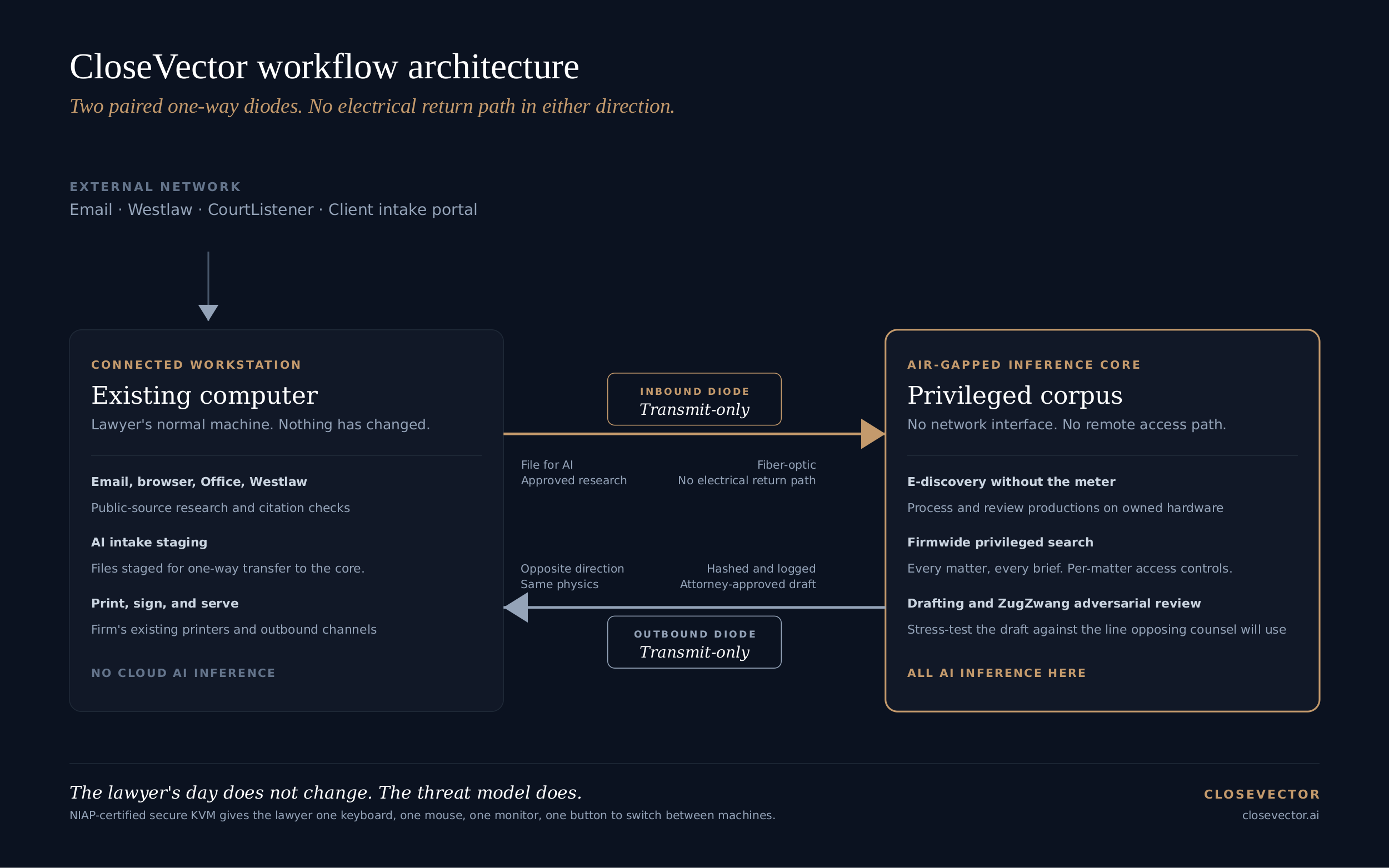
Computer 1
- Client document intake, malware scanning, and file hashing
- Westlaw and CourtListener research
- Exports to Relativity and other review platforms
- Citation verification against live sources
- Standard internet tools the team already uses
Fiber-optic, transmit-only
Fiber-optic, transmit-only
Computer 2
- Privileged matter data, embedded on-premises
- Matter-specific encrypted containers
- Embedding generation and pattern analysis
- Adversarial reasoning and drafting sessions
- Retrieval against the firm's own corpus
- No network interface. No return path.
Operational data path
Client files are handled on the connected workstation under the firm's ordinary document controls. When the lawyer sends a file for AI processing, the appliance packages it for one-way transfer into the core, with malware scanning, hashing, and transfer records under the firm's install policy. Once across, the file is unreachable from any external network.
Matter isolation
Matter-specific encrypted containers create a hard boundary at the storage layer, designed to prevent cross-matter access during normal operation. A malicious file that survives intake controls enters a matter-specific container on a core with no network egress.
Software update path
Updates do not flow through either diode. They arrive on signed, hash-verified USB media and are loaded directly onto the air-gapped core under firm supervision. This is a deliberately separate physical channel from the operational data path.
Lawyer's desk: one keyboard, one screen, one button
A NIAP-certified secure peripheral switch (Protection Profile PP_PSD_V4.0) gives the lawyer a single keyboard, monitor, and mouse that control either machine. She presses a button on her desk to switch contexts. The two computers are never connected to each other through the switch. The switch passes only human input and output signals, with hardware-isolated channels per port and no shared data path between machines.
The filed provisional describes the connected-workstation, fiber-diode, and air-gapped-core architecture, including paired one-way operational data paths. It is the reason a firm does not have to choose between controlled AI and privilege discipline. Inference happens in the core. Approved outputs leave through logged channels the firm operates. The vendor-side path to the privileged corpus is removed by architecture, not by a promise in an MSA.
Deployed without remote access to client files.
Installation is on-premises. Forward-deployed. Led by the system designer. The appliance is installed inside the firm's environment, on-site, on the firm's terms. Initial data embedding happens inside the firm's four walls under the firm's supervision.
No client files are transferred to CloseVector-controlled systems before, during, or after install. No cloud sandbox. No shared Drive. No remote support path that transmits matter data to CloseVector.
There is no remote access path to the inference core. After install, the firm owns the hardware, owns the data, and operates the appliance. Support is session-based and initiated by the firm, without remote shell access, file access, telemetry from the core, or any standing support path into privileged matter data.
This deployment model is built for a firm that needs to tell a serious client exactly where privileged data sits, who can access it, and what record exists if the workflow is challenged.
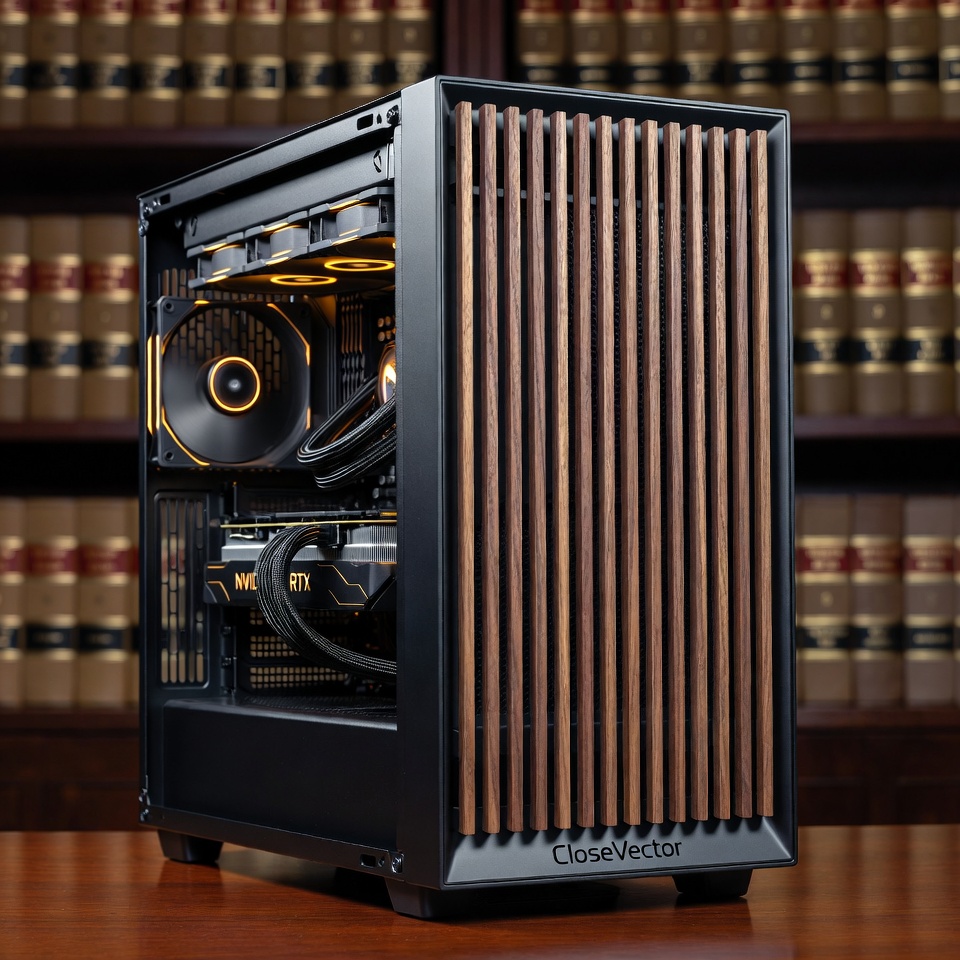
- The CloseVector appliance, firm-owned hardware with a three-year hardware warranty
- Paired hardware data diodes, patent-pending physical-layer privilege boundary
- NIAP-certified secure peripheral switch (Protection Profile PP_PSD_V4.0) for one-keyboard, one-mouse, one-monitor context switching between connected and air-gapped machines
- On-site installation and configuration by the system designer
- Initial data embedding under firm supervision
- On-site training for the matter team, typically three to four hours
- Recovery thumb drive for appliance restoration
- CloseVector Secure Internal Search, with full initial deployment and training
- First full year of software updates, delivered on signed, hash-verified USB media
- Permanent rate lock on future products and engagements
The matter you declined is now someone else's revenue.
The wage-and-hour class action with 140 custodians and 800 gigabytes of Outlook archives. The mass-tort inventory with enough signal to investigate but enough data to make the vendor quote prohibitive. The defense RFP your team priced conservatively because discovery volume made margin uncertain.
For plaintiff-side firms, the regret is the case you could not economically pursue. For defense-side firms, it is the fixed-fee matter you could not price confidently, or the client that moved to a firm with a clearer AI-control story.
Terabyte-scale discovery stops being a vendor quote
Document review tasks that used to trigger per-GB scoping calls run on local hardware with attorney review of the output. No upload queue. No external processing meter.
Data-heavy contingency matters become viable choices
When discovery cost is fixed by owned capacity instead of variable by vendor meter, the firm can choose to pursue matters it would have declined on cost grounds.
Fixed-fee defense work becomes less of a guessing game
The firm can evaluate document volume and case structure before margin disappears into review spend. Pricing moves from fear of the unknown to a controlled operational model.
Intake gets a clearer read before the firm commits
During intake, the appliance can surface structural strengths, weaknesses, and evidentiary gaps in the record, for attorney review. The firm still decides. The map is better.
A five-week window showing accelerating consequences.
In one five-week period, the market produced courtroom consequence, infrastructure vulnerability, judicial impatience, and serious-firm adoption at scale.
Sullivan & Cromwell apologized to the court
A major firm apologized to a federal judge for AI-generated inaccuracies in a filing, acknowledging internal AI policies and secondary review processes had not been followed.2
The plumbing under cloud AI was breached in production
LiteLLM disclosed a suspected supply-chain incident. Datadog Security Labs reported malicious PyPI releases. The middleware between firms and frontier models is no longer theoretically compromisable.4
A federal judge called it a "perilous shortcut"
In a Walmart case, a U.S. judge directly addressed an attorney's AI use in language the bench is now borrowing. Judicial vocabulary is hardening.1
Freshfields showed the adoption side of the divide
Freshfields expanded its Anthropic relationship and announced Claude access through the firm's platform to 5,700 employees. The distinction is not AI versus no AI. It is controlled AI versus borrowed AI.3
Waiting is now an affirmative risk decision.
Corporate clients increasingly expect outside counsel to use AI on their matters. They also want visibility into how it is used, what is billed, and what security and human-review controls exist. Thomson Reuters Institute reported in March 2026 that more than half of corporate legal professionals think outside firms should use AI on their matters, while many said they did not know whether their own outside firms were using AI at all.5
This is a control problem before it is a software problem. If matter data lives with a third-party provider, legal process can run to that provider. An MSA does not repeal 18 U.S.C. §2703. Keeping inference and storage inside firm-controlled infrastructure materially narrows that exposure.6
The ethics floor has moved. ABA Formal Opinion 512 puts competence, confidentiality, communication, supervision, and fees in play for generative AI use. The duty does not move to the model vendor. It remains with the lawyer and the firm.7
The insurance market is moving against vague AI control. Verisk filed optional January 2026 CGL endorsements aimed at generative-AI exposure, including forms CG 40 47 01 26 and CG 40 48 01 26. Renewal conversations are becoming more demanding.8
The evidence rules are catching up. The federal rulemaking process is considering proposed Federal Rule of Evidence 707 for machine-generated evidence. Reliability, explainability, and traceability are moving from best practice toward expected practice.9
What sophisticated clients now ask
- Do you use AI on my matters?
- Where does my data physically go when you do?
- Who sees it, what is logged, and can you prove it?
- Can you produce the audit trail if opposing counsel challenges it?
- What happens to my work product if your vendor gets breached, acquired, or subpoenaed?
United States v. Heppner (S.D.N.Y. Feb. 17, 2026)
The Southern District of New York rejected privilege and work-product protection on the facts before it.10 Narrow facts. Broad implications. Opposing counsel will cite this forward.
Warner v. Gilbarco, Inc. (E.D. Mich. Feb. 10, 2026)
A federal court reached a different result on work product.11 A split is not safety. It is a warning that the cleaner architecture gets the better argument.
What changes between intake and the draft on your desk.
These workflows run against the firm's corpus, inside the firm's appliance, with source-linked output and attorney review before any filing, production, or delivered work product.
Terabyte review starts when the drive lands
Process large productions on the firm's own appliance. No upload queue, no vendor scoping call, no per-GB processing gate before attorneys can see the shape of the record.
Deposition and motion drafts tied to the record
Question sets, complaint scaffolding, and motion-pattern context generated against the record and the theory of the case. Source-linked drafts reach the attorney faster; attorney judgment still governs the work.
Chain of custody built for attorney signature
Tamper-evident, cryptographically verifiable audit trail from source document through processing to verified deletion, with integrated Bates numbering. Built for FRCP 26(g) defensibility.
Who-knew-what-when before the first deposition
Relationship graphs connect entities, dates, communications, and events. Attorneys see the matter structure in a single view, cross-linked to source pages before the witness is across the table.
Five-layer verification before attorney review
Citation verification, temporal consistency, cross-document consistency, adversarial fact-checking, and evidence-strength grading. Designed to surface hallucination failure modes before they reach a filing.
Adversarial war game inside the air-gapped core
Attack, defend, and excavate modes pressure-test the theory of the case against the actual record. Weaknesses surface while the team can still address them, not after opposing counsel finds them.
Regional manager requests that store leads "hold corrections until finance signs off." Linked to three adjacent messages and payroll attachment hash.
Attachment identifies variance by location and custodian. Suggested follow-up: compare against timekeeping entries for the same week.
1. Establish receipt of Q3 variance report.
2. Authenticate PRD-004918 thread.
3. Ask whether payroll corrections were delayed pending finance review.
Output requires attorney review, revision, and approval before use. Linked sources remain visible next to each question cluster.
The committee gets evidence, not assurances.
The money case gets a managing partner's attention. The artifacts below give risk, IT, procurement, and insurance a record they can evaluate.
Chain-of-custody record (synthetic sample)
Procurement control mapping (excerpt)
| Control | Implementation | Evidence |
|---|---|---|
| Data at rest | LUKS2 full-disk on inference coreIn place | Install checklist §4.2 |
| Matter isolation | Matter-specific LUKS encrypted containersIn place | Install checklist §4.3 |
| Network egress (core) | No NIC. Egress only via outbound diode (transmit-only).Physical | BOM, photo, §3.1 |
| Privilege preservation | Matter-level filter on retrievalIn place | Audit log QUERY filter |
| Citation verification | Five-layer check pre-outputIn place | CITE_VER log line |
| Attorney review gate | Output sealed only on ATTY_OKIn place | ATTY_OK + SEAL log lines |
| Audit retention | WORM local, 7-year defaultConfigurable | Install spec §6 |
Privileged work stays in infrastructure the firm controls
The answer to "where did my data go" is not a subprocessor map. It is the air-gapped inference core in the firm's environment.
Outputs are built to be challenged
Inference, retrieval, citation checks, attorney review, and sealed output records are logged. The firm produces a record, not a vendor assurance.
The approval materials arrive on day one
Architecture diagrams, control matrix, sample audit logs, bill of materials, implementation plan, and provisional patent reference are packaged for committee review.
The connected workstation has no network path into the corpus
A bad actor limited to the web-connected workstation has no network path into the inference core. The boundary is physical, not permission-based.
The objection list already has answers.
Most AI procurement cycles slow down because each answer creates a new dependency. This one moves the other way: fewer data paths, fewer vendors touching privileged work, fewer recurring charges.
| Committee objection | CloseVector answer |
|---|---|
| Are we sending client files to a vendor? | No. Privileged matter data is embedded on-premises under firm supervision and lives in the air-gapped inference core. No client files are transferred to CloseVector-controlled systems. |
| Can CloseVector remote into the matter corpus? | No remote access path to the inference core. Support is session-based, firm-initiated, and conducted without remote shell access, file access, or telemetry from privileged matter data. |
| How do lawyers still research and export? | The web-connected workstation handles Westlaw, CourtListener, citation verification, and exports to Relativity and other review platforms. Once ingested, the privileged corpus has no network return path. |
| Does the lawyer have to use two computers? | No. A NIAP-certified secure peripheral switch (Protection Profile PP_PSD_V4.0) gives the lawyer one keyboard, one monitor, and one button on her desk. The two computers are never connected to each other through the switch. |
| What prevents policy failure? | Two hardware-enforced unidirectional data gateways. Both diodes are physical-layer controls, not cloud-policy settings. |
| Can we defend the workflow to clients, carriers, and the court? | Committee Kit materials include the architecture diagram, control matrix, sample audit logs, bill of materials, deployment documentation, and provisional patent reference. |
| What does this eliminate? | Vendor telemetry from the inference core, recurring seat fees, per-token charges, per-GB processing fees, external inference custody, and a vendor-side path to the privileged corpus. |
| What if CloseVector ceases operations? | The appliance operates inside the firm's environment. The firm owns the hardware, data, and installed appliance. Business-continuity terms, support scope, warranties, and transition rights are set in the written engagement documents. |
| What are we actually buying? | A $40,000 one-time engagement that includes the firm-owned appliance, paired hardware data diodes, NIAP-certified secure KVM for frictionless context switching, on-prem install, initial data embedding, matter-team training, recovery media, Secure Internal Search deployment, first-year software updates on signed USB media, permanent rate lock on future products and engagements, zero per-seat, per-token, and per-GB vendor fees inside installed capacity. Confidential by default. Terms set in the written engagement documents. |
The person who built it installs it.
The engagement includes direct implementation accountability: architecture review, on-site installation, initial data embedding, matter-team training, and first live matter support from the person responsible for the system's design.
What the first thirty days look like. Day one: Committee Kit delivered. Week one: architecture review with the firm's IT and risk leads. Weeks two and three: install window scheduled, on-prem deployment, and initial data embedding under firm supervision. Week four: first live matter workflow on the appliance, with on-site support.
CloseVector was designed for adversarial legal work: privilege-preserving data movement, source-linked inference, tamper-evident logs, and physical-layer separation between external research tools and the privileged corpus.
Two decades of institutional quantitative trading and risk management shaped the design discipline: build systems that survive adversarial conditions, tail events, and real capital at risk. That is why the privilege architecture is a physical constraint, not a policy preference.
What the engagement receives: direct implementation accountability, first-year software updates included in the engagement, and Year 2+ software updates, support, roadmap inclusion, and future engagements offered at the locked rate set in the engagement documents.
The scarce resource is not software. It is the system designer's calendar.
The constraint is operational. Installs are on-premises and personally led by the system designer. Each deployment requires architecture review, an on-site installation window, firm-supervised initial embedding, and first live matter support. 2026 installation capacity is limited by the number of deployments CloseVector can complete without diluting implementation quality.
A firm that wants a 2026 install window should begin architecture review before another committee cycle consumes the calendar. The Committee Kit enables the actual decision makers to review the architecture, control model, bill of materials, and implementation plan before scheduling a deployment discussion.
Waiting preserves the old cost structure. Another renewal. Another client questionnaire answered with vendor language. Another fixed-fee matter priced defensively. Another data-heavy case declined because the discovery meter made it appear uneconomic.
Owned infrastructure. Permanent rate lock. Confidential by default.
This is the entry point into a firm-owned legal AI capability that can be defended to clients, procurement, insurance carriers, and the court. It is also the point where the firm stops treating AI growth like a recurring vendor meter.
At the next risk-committee meeting, the question will be straightforward: "How did we handle AI this cycle?" The stronger answer is an owned appliance, no marginal vendor fees per approved matter, a clean audit trail, a physical-layer data boundary, an on-site install, and matters the old cost structure would have rejected back on the table.
For the security reviewer: read the deployment boundary, threat model, and controls →
Get the Committee Kit
Hardware specifications, capacity classes, support scope, expansion options, and final commercial terms live in the Committee Kit and the written engagement documents. This brief is the introduction. The kit is the procurement record.
Selected authorities and public developments
- Reuters, "Lawyer's use of AI was 'perilous shortcut' in Walmart case, U.S. judge says," April 15, 2026.
- Reuters, "Sullivan & Cromwell law firm apologizes for AI hallucinations in court filing," April 21, 2026.
- Freshfields, Anthropic collaboration announcement, April 23, 2026.
- LiteLLM, "Security Update: Suspected Supply Chain Incident," March 2026; see also Datadog Security Labs reporting on malicious PyPI releases 1.82.7 and 1.82.8.
- Thomson Reuters Institute, "The great AI disconnect," March 2026.
- 18 U.S.C. §§ 2702-2703 (Stored Communications Act provisions governing voluntary and compelled disclosure by service providers).
- American Bar Association, Formal Opinion 512, July 29, 2024.
- Independent Agent, "Verisk to Roll Out New General Liability Exclusions for Generative AI Exposures," October 21, 2025, describing Verisk ISO forms CG 40 47 01 26 and CG 40 48 01 26 as optional January 2026 CGL endorsements. Coverage depends on carrier adoption and actual policy language.
- Reuters, "Proposed AI evidence rule highlights new challenges for federal practitioners," April 23, 2026, concerning proposed Federal Rule of Evidence 707 and machine-generated evidence.
- United States v. Heppner, 2026 WL 436479 (S.D.N.Y. Feb. 17, 2026), Memorandum Order.
- Warner v. Gilbarco, Inc., 2026 WL 373043 (E.D. Mich. Feb. 10, 2026).
- Hoffman, Dean, "Multi-Architecture Artificial Intelligence System for Legal Applications with Distributed Trusted Execution Environments, Air-Gapped Embedding Protection, and Comprehensive Hallucination Prevention," Provisional Patent Application, filed August 12, 2025. See particularly Claim 20 (data diode-enabled air-gapped legal AI system).
Important notices
Not legal advice. This document is informational material about CloseVector's technology and founding-client program. Nothing in it constitutes legal advice. Nothing in it creates an attorney-client relationship between any reader and CloseVector, its principals, or any affiliate. Readers evaluating their own obligations under the rules, statutes, and cases referenced here should consult their own counsel.
Capability scope. Every capability described in this brief produces output for attorney review. Nothing the system produces is a substitute for attorney judgment, analysis, or the exercise of professional responsibility. Capabilities described as "case evaluation," "filing pattern analysis," "deposition questions," "complaint drafting," and similar are information-preparation tools. All outputs require attorney review, revision, and responsibility before being filed, delivered, or relied upon. CloseVector does not practice law, provide legal advice, or predict case outcomes. Pattern analysis describes observed patterns in source material and does not guarantee, forecast, or represent any specific outcome in any specific matter.
Forward-looking statements. Statements about roadmap items, build schedules, and capabilities shipping in the future are expressions of present intent and current development plans. Delivery dates and scope may change. Capabilities described as "near-term," "on the schedule," or "next build" are not yet in production and should not be relied upon for contracting decisions prior to the founding engagement's written terms.
Commercial terms. The $40,000 founding engagement, founding-client cap, permanent rate lock, and confidential founding-client program described above are the current terms of the founding-client program as of April 25, 2026. Specific engagement scope, deliverables, warranties, transition terms, confidentiality terms, and support terms are set forth in the written engagement documents provided to prospective founding firms. This brief does not itself constitute an offer to contract.
Comparative cost claims. Statements comparing CloseVector's owned-infrastructure cost model to cloud-AI providers' per-seat, per-token, and per-GB cost models describe structural differences in commercial pricing models. Specific dollar amounts, ROI, and savings vary by firm based on usage volume, matter mix, current vendor arrangements, installed appliance capacity, and other factors. Firms should evaluate their own usage and cost structures against the described model before making procurement decisions.
Additional notices. Case citations, statutory references, and regulatory references identify the doctrinal framework CloseVector's architecture is designed to operate within; application depends on facts and jurisdiction. Insurance references describe standardized policy language that carriers may or may not adopt; confirm coverage with broker or carrier. Third-party references, including Westlaw, CourtListener, and Relativity, are for descriptive context only and do not imply endorsement or integration certification. Patent references describe the status of a provisional patent application filed August 12, 2025; a provisional application does not grant patent rights. Product-development references describe design methodology, not a guarantee or prediction of outcomes; prior results do not guarantee similar outcomes.